

ATOVA's November/December Newsletter! 🎄

Welcome to the November/December edition of the Atova Newsletter! Thank you all for joining us this year as we explore the latest developments around the world in novel food regulations. 🌍
As the year draws to a close, we would like to extend our huge thanks to all our clients for your trust and collaboration throughout the year. It has been a pleasure supporting you as you navigate the regulatory landscape while bringing your innovative products to market. We truly value working alongside you and would like to wish you and your teams a happy holiday season and a successful year ahead. We look forward to continuing our work together in the new year. 🎄✨
With best wishes,
The Atova team 💚🌱

It has been a busy and rewarding time here at Atova, with plenty of activity both within our growing team and across the wider regulatory and food innovation landscape. From welcoming new Atovees to sharing expertise at international conferences and collaborating on exciting HORIZON projects such as PLANTOMYC and EPIC-SHIFT, here are some highlights from the last few weeks.
Welcoming new team members to Atova
It’s been a busy and exciting time here at Atova as we continue supporting our clients with innovative projects across the regulatory landscape. Behind the scenes, our team has been growing, and we’re delighted to introduce five fantastic new colleagues who have recently joined us!
Please join us in welcoming:
🔬 Sarah Harrison – Regulatory Scientist
🧪 Ana Diges – Regulatory Scientist
🧫 Chee-Seng Hee – Regulatory Scientist
🌾 Evangelia Padenoglou – Regulatory Scientist
🧬 Oana Kubinyecz – Regulatory Scientist
We’re incredibly excited to have Sarah, Ana, Chee, Evangelia and Oana join our team, with each of them bringing a wealth of unique expertise and passion to the work we do.

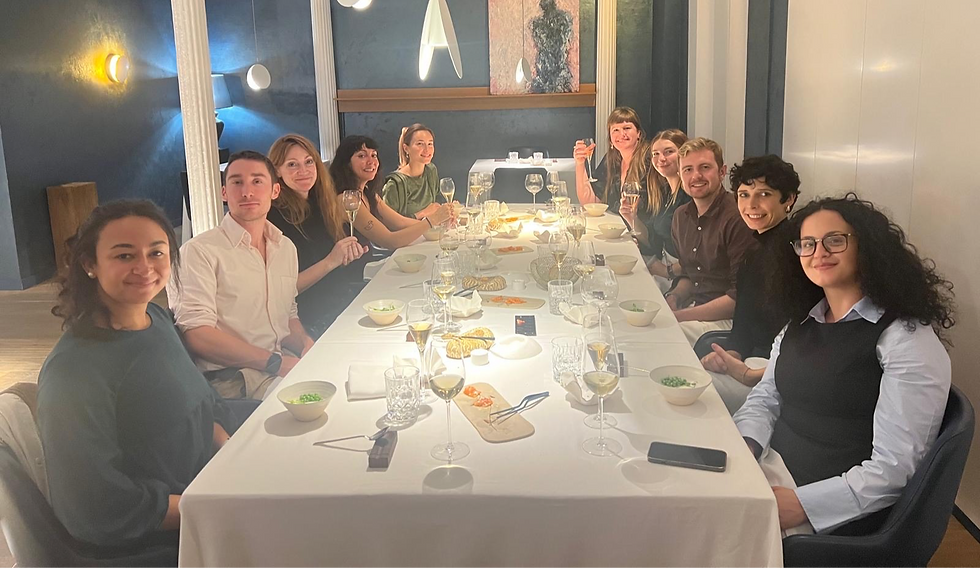
Team Christmas Lunch
To celebrate all the team’s hard work throughout the year, the Atova team gathered for a well-deserved, festive Christmas lunch. It was a great opportunity to step away from our desks, enjoy some great food and reflect on everything we’ve accomplished together. It was a wonderful way to start the celebrations to the holidays ahead! 🎄💚
Alternative Protein 4.0 Conference
Diana Rueda, PhD, Atova’s Global Regulatory Affairs Manager, recently spoke on Day 1 of the Alternative Protein 4.0 Conference by TECH 4.0! Her session, “Novel Food Regulatory Heatmap – Global Landscape and Key Considerations,” offered a clear and insightful overview of regulatory frameworks for novel foods across major regions. The talk explored differences in timelines, processes, and the availability of positive precedents, whilst outlining practical considerations to help prioritise regulatory pathways and plan efficient market-entry strategies.
Closing the Food Innovation Gap
Together with Anna Handschuh from the Ministry of Future Affairs and Karin Verzijden from Axon Lawyers, Atova CEO Hannah Lester collaborated in co-authoring the newly released report “Closing the Food Innovation Gap!”.
📊 What’s Inside the Report
A framework for a pan-European regulatory sandbox for emerging foods and complementary proteins
An opt-in mechanism for Member States eager to benefit from food innovation and biotech
Provides a comparison of the EU’s novel foods approval process with other global market approval processes, regarding timelines and costs.
Practical steps to increase regulatory efficiency without changing the legal process on an 18-month timeline rather than today's average of 30 months (which could be extended to up to five years)
Recommendations that lay out how fragmentation of sandbox approaches across Member States can be decreased
What Europe needs to ensure innovators scale first in Europe and restore industry and investor confidence
Designed for Member States that want to help accelerate safe, science-based regulatory processes while maintaining high food-safety standardsIn November, 80 participants from across Europe’s food manufacturing and biotech sectors were brought together to discuss the report at the European Parliament and identify what is needed to scale food biomanufacturing in the EU. Thank you to all those who attended for the valuable discussion and contributions, with thanks to Juha-Pekka Pitkänen (Solar Foods), Stéphane Mac Millan (Verley), Frederieke Reiners (GEA Group), Victor Meijer (Invest-NL), Marie Wennergren, Mélody Violton (CPT Capital), Linda Nielsen (Københavns Universitet - University of Copenhagen) and Tõnis Tänav (Ministry of Rural Affairs of Estonia / EIS | Enterprise Estonia).
Learn more and download the report: https://www.closingthefoodinnovationgap.eu/

PLANTOMYC
We are proud to be a key partner in the PLANTOMYC project. The project aims to transform the alternative protein sector through developing hybrid ingredients by combining plant-based proteins with mycelial protein biomass (MPB) — a novel, sustainable biomass derived from filamentous fungi. As part of this consortium, Atova helps to ensure that the development of sustainable alternative protein sources based on fungal mycelium and plant proteins comply with EU regulatory standards.🔍 Learn more about our role in the project here.

Here we let you know the latest European updates from November and December 2025, with data retrieved from the European Food Safety Authority (EFSA) and the European Commission (EC).
EFSA Updates
Recent Novel Food Dossier and Traditional Food Notifications Received by EFSA
There were five dossiers received by EFSA in November through to mid-December :
Authorisation of N-(1-carbamoyl-2-phenyl-ethyl) butyramid as a novel food (12/11/2025)
Authorisation of Gamma -Aminobutyric acid as a novel food (13/11/2025)
Authorisation of Schizochytrium sp. (LU310) oil as a novel food (18/11/2025)
Authorisation of Ginger oleoresin obtained by CO2 supercritical as a novel food (10/12/2025)
Authorisation of Coffee fruit extract as a novel food (16/12/2025)
Validated Dossiers
There was one validated dossier published on Open EFSA in November.
Modification of the authorised 2’-Fucosyllactose (2’-FL)
Received on 07/10/2025 and validated on 14/11/2025
Dossiers Considered Non-valid and Withdrawn
There was one dossier considered non-valid and withdrawn during November.
Name of Product | Dossier Received by EFSA | Declared Not Valid/ Withdrawn | Time until withdrawal |
15/04/2024 | 26/11/2025 | 19.5 months |
EFSA Published Opinions
Seven EFSA novel food opinions were published on Open EFSA during November and the beginning of December.
Name of Product | Dossier Received by EFSA | Validated | Opinion Published | Months until Opinion |
15/01/2020 | 6/09/2020 | 03/11/2025 | 69.5 months | |
29/08/2022 | 11/10/2023 | 28/11/2025 | 39.5 months | |
30/06/2020 | 07/01/2021 | 01/12/2025 | 66 months | |
04/06/2021 | 20/05/2022 | 03/12/2025 | 55 months | |
04/06/2021 | 20/05/2022 | 03/12/2025 | 55 months | |
06/03/2023 | 29/02/2024 | 03/12/2025 | 33.5 months | |
27/05/2025 | 18/07/2025 | 16/12/2025 | 8.5 months |
EFSA Public Consultations
There were six novel food public consultations completed in November through to mid-December.
Application for authorisation of UV treated mealworm oil as a novel food
Application for authorisation of Synthetic kynurenic acid as a novel food
Application for authorisation of Dihydroberberine as a novel food
Application for a modification of already authorised 2’-Fucosyllactose (2’-FL) as a novel food
Application for authorisation of Hydroethanolic Extract of Sceletium tortuosum and/or Sceletium crassicaule as a novel food
Application for authorisation of Plant-based Drink from Roasted in-shell Almonds as a novel food
There were also two other public consultations including:
EFSA Working Group Meeting
The 163rd NDA Panel Plenary meeting of the Scientific Panel on Nutrition, Novel Foods and Food Allergens was held on 19-20thNovember. The agenda indicated that points of discussion focused on applications related to the extension of use of galacto-oligosaccharides (GOS), cannabidiol (CBD) as a novel food, broad-spectrum CBDs, novel foods with pharmacological effects, preparations from the fruits of sweet and bitter fennel, plant preparations containing berberine, and other plant preparations under evaluation for safety in use. Read the full agenda here.
EFSA announces upcoming changes in the application process for novel foods and other regulated products
European Food Safety Authority (EFSA) will be rolling out several upcoming changes that aim to make the application process for non-pesticide applications more efficient and transparent. Here’s what applicants need to know:
From 27 November 2025Pre-publication notifications of an adopted scientific output
Sent within 11 working days after adoption
4 working day “add comment” window in ESFC upon receipt of notification
48 hour notification before publication of scientific output in EFSA journal
The EFSA administrative Guidance’s were updated on 27th November, including those on:
From 1 January 2026
Deadline monitoring relating to requests for information (RFIs) or additional data requests (ADRs)
Automatic reminders: 1 week before, 1 week after, and 15 working days after deadlines
Concluding application process from non-responding applicants
After 3 unanswered reminders for RFI – application may be declared non-valid
In risk assessment phase – the clock restarts and the panel will finalise its opinion based on available data
Deadline extensions
EFSA will allow a maximum of two extensions per RFI or ADR
A third extension may be granted but only in cases for reasons beyond the applicant's control
Not applicable for health claim applications
Additional data checks for an ADR and follow-up
EFSA will aim to check additional data completeness within 15 working days of receipt
If information received in ADR reply is incomplete, a follow-up ADR will be issued and clarifications checked within 5 working days of receipt
Spontaneous submissions
Considered based on time left to deliver, data volume and data relevance
Not assessed if submitted <10 working days before plenary meeting (unless safety-related)
The EFSA administrative Guidance’s were updated on 27th November, including those on:
European Commission Updates:
Novel food approvals
Amending Implementing Regulation (EU) 2017/2470 as regards the conditions of use of the novel food Schizochytrium sp. (ATCC PTA-9695) oil
Extension of use submitted 4th March 2025, approved 7th November 2025 ( 8 months to approval)
Novel Food application submitted 30th April 2024 and approved on 7th November 2025 (18 months to approval)
Novel food application submitted on 10th November 2021, approved on 6th November 2025 (48 months to approval)
Article 4 Updates
Czech Republic
The outcome of three Article 4 novel food consultations submitted to the Czech Republic, Ministry of Agriculture, Food Safety Department have recently been published. This included consultations on benfotiamine, chondroitin sulfate from Tremella fuciformis, and the novel food status of a mixture of plant extracts and purified bioactive substances.
Chondroitin sulfate from Tremella fuciformis
➡ The application concerns Chondroitin sulfate from Tremella fuciformis (Berk). The chondroitin sulfate (purity >90%) isolated from the fruiting body of this edible mushroom has been produced using hydroalcoholic extraction, purification, and chemical sulfation with sulfuric acid. The ingredient is intended for use in food supplements with a maximum daily dosage of 500 mg/day. Although the fruiting body of Tremella fuciformis is included in the national positive lists of Spain, Belgium and Germany, the isolated and purified chondroitin sulfate from the mushroom has no history of significant consumption before 15 May 1997.
❌Novel food
Benfotiamine
➡ Benfotiamine is a chemically synthesised compound consisting of a derivative of vitamin B1 (thiamine) and a benzoyl group and is intended for use as a food supplement. The production of benfotiamine involves the esterification of thiamine hydrochloride (vitamin B 1) with benzoyl chloride under catalytic conditions producing Sbenzoylthiamine which is then phosphorylated.
❌Novel (has chemically synthesised compounds and has no significant history of consumption as a food ingredient before 15 May 1997 in the EU.)
Mixture of plant extracts and purified bioactive substances
➡ The request for consultation concerns the following seven ingredients:
• Apigenin (≥ 98%) isolated from the aerial parts of Matricaria chamomilla L.
• Quercetin (≥ 98%) isolated from the leaves/flowers of Sophora japonica L.
• Pterostilbene (≥ 99%) isolated from the wood of Pterocarpus santalinus L.
• Gynostemma pentaphyllum extract (standardized to 80 % gypenosides)
• Centella asiatica (Gotu kola) extract (standardised to 40 % triterpenes)
• Cycloastragenol (≥ 98%) isolated from the root of Astragalus membranaceus
(Fisch.) Bge.
• Fisetin (≥98%) isolated from the bark ofCotinus coggygriaScop.
❌Novel – there is no significant history of consumption of the mixture of plant extracts and purified bioactive substances before 15 May 1997.
Spanish Food Safety and Nutrition Agency O.A.
The outcome for an Article 4 novel food consultation has been submitted to the Spanish Food Safety and Nutrition Agency O.A, for the stems, fruits, leaves, and tender shoots of the plant species Crithmum maritimum L. with the indented use as a food ingredient.
✅ Leaves, stems and tenders shoots - Not novel
❌ Fruit - Novel
The applicant provided history of significant consumption of the leaves, stems and tender shoots before 15 May 1997. However, there was no history of the consumption of the fruits in the European Union before this date, so is therefore considered novel.🔗Read more here
Standing Committee on Plants, Animals, Food and Feed Section Novel Food and Toxicological Safety of the Food Chain
The agenda for the meeting held on 15th December is available here. The minutes for which are still pending.
Guidance document describing the food categories in Part E of Annex II to Regulation (EC) No 1333/2008 on Food Additives
This recently published guidance document outlines the food categories in Part E of Annex II to Regulation (EC) No 1333/2008 on Food Additives. It has been developed by the Comission services in collaboration with Member States’ food-additive experts and relevant stakeholders with the aim to support national control authorities and the food industry in ensuring consistent and accurate application of EU food-additive legislation. Read the guidance here.
EU Biotech Act
The European Commission's EU Biotech Act represents a significant step forward towards modernising the regulatory framework for biotechnology in Europe. This aims to simplify the existing regulatory framework and remove regulatory burdens, which are hindering innovation and competitiveness. This includes noteworthy aspects for companies focused on fermentation, microbial innovation and biomanufacturing, with the Act offering a more proportionate, risk-based approach for genetically modified micro-organisms. This includes the creation of a low-risk category for certain uses in food, feed and agriculture. These measures seek to clarify and reduce procedural timelines across the development cycle and provide a more flexible regulatory environment, through the introduction of regulatory sandboxes and increasing use of data. Find out more here.

FSA Board Meetings
The FSA Board meeting was held on the 10th December in Reading. The agenda for this meeting included discussions on the evaluation of the Meat Charging Discount Regime, FSA’s position on the Codex Precautionary Allergen Labelling Standard including allergen thresholds, the annual Governance Report, and updates on the National Food Crime Unit and on communications. Read the full agenda here.
Previous meeting recordings are available here.
Advisory Committee on Novel Foods & Processes- Subcommittee on Products of Genetic Technologies Destined for Food and Feed Purposes (ACNFP_PGT)
The 22nd ACNFP_PGT Subcommittee meeting was held on the 9th December. The agenda for this meeting is currently available to read online. On the agenda for to be discussed included reviews of Genetically modified Soybean MON94313, RP2261, and genetically modified Maize Bt11 × MIR162 × MZIR098 × DP4114 × NK603, RP2288. Read the full agenda here.
FSA and FSS publish their first guidance documents on cell-cultivated products
The Food Standards Agency (FSA) and Food Standards Scotland (FSS) have released the first guidance for cell-cultivated products (CCPs). An important milestone for food innovation in the UK. These are the first of several pieces of guidance being produced by the Food Standard Agency and Food Safety Scotland’s CCP Sandbox Programme, helping to provide clarity to innovators and businesses on how to demonstrate product safety.
This new guidance covers:
Classification of cell-cultivated products produced from animal cells – which are defined as products of animal origin and must apply existing food safety regulations during their production process.
A framework for allergenicity and nutritional quality assessments
👉 Read the full guidance here.

The first AFIC (animal food ingredient consultation) has been published
This first AFIC has been published, with this consultation referring to Rice Protein Concentrate, intended as a source of protein for cats and dogs.
Date completed: 14th November 2025.
FDA has published its first Animal Food Ingredient Consultation (AFIC), marking a major shift in how new animal food ingredients are reviewed in the US. Until recently, many feed ingredients entered the market through definitions developed with the Association of American Feed Control Officials (AAFCO). This system was supported by a long-standing MOU between FDA and AAFCO, which allowed AAFCO ingredient definitions to function as a de facto pathway for acceptance at the state level.
With the expiration of that MOU in 2024, FDA clarified that it alone holds regulatory authority for evaluating and approving new animal food ingredients. To provide a modern, FDA-led pathway, the agency created the AFIC process, offering a transparent mechanism - similar in spirit to human-food GRAS notices - for reviewing novel feed ingredients.The release of the first completed AFIC signals the beginning of this unified, FDA-centric framework for animal food ingredient oversight.
FDA
The FDA shutdown came to an end on 12th November, and the agency has returned to normal operations. Reviews of submissions and other activities related to novel foods are expected to proceed as usual.
Rule to Tighten GRAS Oversight Moves to Whitehouse
The FDA has sent a proposed rule to the White House to tighten Genetically Recognised as Safe (GRAS) oversight. This proposed rule would amend the Code of Federal Regulations to enforce stricter GRAS oversight, including making FDA notification of GRAS submissions mandatory for most substances, the GRAS notice inventory must be maintained having all GRAS substance notifications and their intended uses listed, and the clarification of the process undertaken to determine that a substance is not GRAS. Find out more here.

Food Standards Australia New Zealand (FSANZ)
Administrative assessment
Food Standards Australia New Zealand (FSANZ) has completed an administrative assessment and accepted the following application. Assessment has now commenced and an opportunity to comment will be notified at a later date.
Annual Report
FSANZ has released its 2024–25 Annual Report showcasing the work they have completed in ensuring a safe and trusted food supply in Australia and New Zealand.
One Health Network
The One Health Network aims to strengthen Australia’s preparedness for emerging health challenges by enabling a coordinated response to cross-sector issues, including those affecting food safety, through sharing data, scientific insights and expertise. Find out more here.
Canada
Health Canada is currently seeking comments on its proposed risk-based approach for the authorization of infant food for a special dietary purpose. These foods fall under Division 25 of the Food and Drug Regulations and the comment period is open from 26th November 2025 until 25th January 2026. Find out more here.
India
The list of applications Approved/Rejected/Closed/Withdrawn/Status under the Food Safety and Standards (Approval for Non-Specified Food and Food Ingredients) Regulations was updated earlier this month. Read the full document here.
Biokraft Foods has become the first applicant to have a cultivated chicken dossier accepted and placed under risk assessment by the Food Safety and Standards Authority of India for approval as a non-specified food and food ingredient.
Thailand
Food and Agriculture Organisation (FAO)
FAO participation in high-level and technical events, including those held from 2nd-4th November in Singapore and from 13-15th November in Seoul, highlighted a shared message from regulators and scientific institutions. This being that as new food production systems, such as cell-based food production and precision fermentation continue to evolve, international cooperation is crucial to support effective and science-based food safety assurance processes.
World Health Organisation (WHO)
JEMRA (Joint FAO/WHO expert Meeting on Microbiological Risk Assessment) convened a series of meetings to prepare and develop risk assessments for Listeria monocytogenes in various foods. Several risk assessment models were developed and evaluated for characterising the risk of listeriosis in the consumption of diced ready-to-eat cantaloupe, frozen vegetables, and cold-smoked ready-to-eat fish. In addition to this, an updated dose–response model for L. monocytogenes was developed.
FAO/WHO
FAO and WHO hosted an ad-hoc joint FAO/WHO Expert Consultation on Risk Assessment of Food Allergens – Reference Dose(s) (RfDs) for Cereals Containing Gluten or Gluten. This meeting was held between on 3rd-7th November at the FAO headquarters in Rome. This consultation brought together international experts to provide scientific advice in response to a request from the Codex Alimentarius Commission.
Malaysia
Malaysia’s Islamic Authority declares that cultivated meat can be halal
The department of Islamic Development Malaysia (JAKIM), through the National Muzakarah Committee, has released a landmark ruling in stating that cultivated meat products can be considered halal, provided certain conditions are met. This comes only months after the National Cultivated Meat Feasibility Study was completed by Malaysia. View the ruling here.
Subscribe to keep up-to-date with all the major regulatory updates & news:


Comments